
If you’re planning a new business website, one of the first decisions you’ll need to make is what platform to build it on.
For many businesses, the choice comes down to two options (well, there are more than two options in all honesty, but we’ll stick what what we think you need to consider):
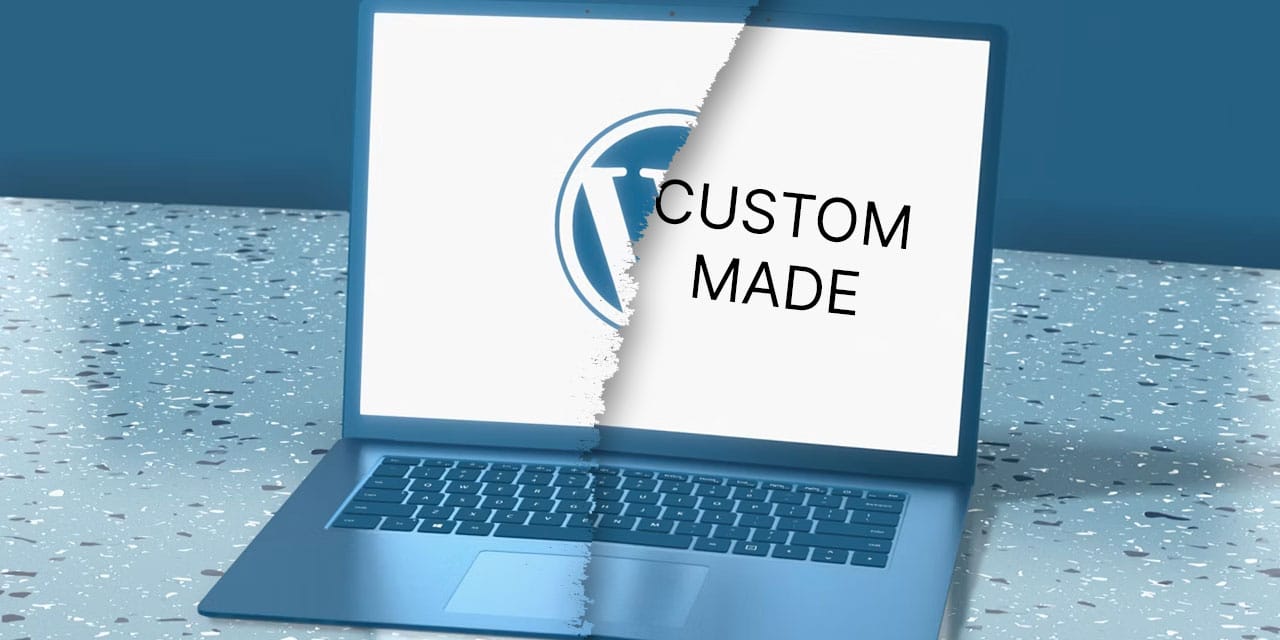
WordPress or a custom-built website?
You’ll find plenty of opinions online about which approach is better. Some developers swear by custom coding, while others believe WordPress is the obvious choice.
The reality is a little more nuanced.
Both approaches have advantages and disadvantages, and the right choice depends on what your business actually needs your website to do.
For many small and medium-sized businesses looking for website design in Perth, WordPress provides an excellent balance of flexibility, functionality and cost. But there are situations where a custom-built website can make sense.
Let’s look at the differences.
What Is WordPress?
WordPress is a content management system, or CMS, that allows businesses to create and manage website content without needing to code every page from scratch.
It powers a huge number of websites around the world and has become particularly popular with businesses because it provides flexibility without requiring everything to be developed from the ground up.
A WordPress website can include:
- Service pages
- Blogs
- Contact forms
- Galleries
- Ecommerce
- Booking systems
- Membership areas
- Integrations
- Custom functionality
One of its biggest advantages is that a business can continue adding and updating content as it grows.
What Is a Custom-Built Website?
A custom website is developed specifically for a particular business or project rather than being built using a general-purpose CMS such as WordPress.
This can provide greater control over:
- Functionality
- Design
- Performance
- Database structure
- Integrations
- User experience
Custom development can be particularly useful when a business has highly specialised requirements that aren’t easily achieved using existing WordPress functionality.
However, that additional flexibility can also mean additional development time and cost.
WordPress vs Custom Website: What’s the Difference?
The biggest difference is essentially this:
WordPress gives you a flexible foundation to build upon, while custom development gives you greater control over the underlying technology.
Neither approach is automatically better.
The important question is which one is appropriate for your business.
Cost
For many businesses, WordPress can be more cost-effective because developers can build on an established platform rather than creating every component from scratch.
Custom development generally requires more development time, particularly when specialised functionality is involved.
That doesn’t mean custom websites are necessarily poor value.
If your business genuinely needs custom functionality, the additional investment may be worthwhile.
But if you simply need a professional business website with standard functionality, custom development may provide capabilities you don’t actually need.
Design Flexibility
There’s a common misconception that WordPress websites all look the same.
They don’t.
A professionally designed WordPress website can be customised extensively to reflect your:
- Brand
- Colours
- Typography
- Photography
- Content
- Layout
- User experience
The fact that WordPress is the underlying platform doesn’t dictate what the finished website has to look like.
For most businesses, there is plenty of flexibility to create a unique online presence.
Custom development can provide even greater control, particularly when a website requires an unusual or highly specialised interface.
Ease of Updating Your Website
This is one of WordPress’s biggest advantages.
A well-built WordPress website allows business owners or their staff to update content without needing to modify code.
You can typically:
- Add blog posts
- Update service information
- Change images
- Add pages
- Update contact details
- Publish news
- Manage products
For a busy business owner, this flexibility can be extremely valuable.
You don’t necessarily want to contact a developer every time you need to change a paragraph on your website.
SEO and Google Rankings
Another common question is whether WordPress is better for SEO.
The answer is that the platform itself doesn’t guarantee rankings.
Google doesn’t simply rank WordPress websites higher because they’re built with WordPress.
What matters is how well the website is built and optimised.
Important factors include:
- Website speed
- Mobile performance
- Quality content
- Page structure
- Internal linking
- Technical SEO
- User experience
- Backlinks
- Search intent
A properly built WordPress website can be extremely SEO-friendly.
Likewise, a poorly developed custom website can perform badly in search results.
For businesses targeting terms such as website design Perth, the quality of the website and its SEO strategy matter far more than whether the underlying platform is WordPress or custom code.
Website Speed and Performance
Website speed is important for both users and search engines.
A poorly configured WordPress website can become slow, particularly if it’s overloaded with unnecessary plugins, large images or poorly written code.
However, a well-built WordPress website can be fast and highly efficient.
Custom websites can also be extremely fast because the developer has complete control over the code.
The key takeaway is that platform choice isn’t the only factor that determines performance.
Good development practices matter.
Security
Security is another area where WordPress sometimes gets an unfair reputation.
Because WordPress is so widely used, it is naturally a target for automated attacks.
That makes proper maintenance important.
A secure WordPress website should include:
- Regular software updates
- Strong passwords
- Appropriate user permissions
- Reliable backups
- Secure hosting
- Monitoring
- SSL/HTTPS
Custom websites aren’t automatically immune to security problems either.
Any website can have vulnerabilities if it’s poorly developed or maintained.
Plugins: Advantage or Disadvantage?
One of WordPress’s biggest strengths is its enormous ecosystem of plugins.
Need a contact form?
There’s a plugin.
Need ecommerce?
There’s a plugin.
Need SEO functionality?
There’s a plugin.
Need bookings?
There’s probably a plugin.
This can significantly reduce development time and cost.
But there’s a catch.
Adding too many plugins can create:
- Performance issues
- Compatibility problems
- Security risks
- Maintenance requirements
A professional developer should therefore avoid installing plugins simply because they exist.
The goal should be to use the right tools for the job.
When Does a Custom Website Make Sense?
There are situations where custom development is absolutely appropriate.
For example, a custom website may make sense if you need:
Complex Business Systems
If your website needs to interact with sophisticated internal systems, databases or business software, custom development may provide greater flexibility.
Highly Specialised Functionality
If your website needs functionality that doesn’t exist within the WordPress ecosystem, custom development may be the better option.
Large-Scale Applications
Websites that operate more like software applications may benefit from a custom technology stack.
Very Specific Performance Requirements
In some circumstances, having complete control over the underlying code can provide performance advantages.
The important thing is to identify these requirements before deciding on the platform.
When Is WordPress the Better Choice?
For many businesses, WordPress is a practical and flexible option.
It can be particularly well suited to:
- Small businesses
- Professional services
- Trades
- Consultants
- Local businesses
- Community organisations
- Retailers
- Service businesses
- Content-driven websites
If you need a professional website that can grow with your business without requiring a large development budget, WordPress is worth serious consideration.
What About Future Growth?
A common concern is:
“Will we outgrow WordPress?”
For most small and medium-sized businesses, probably not.
A well-designed WordPress website can grow considerably.
You can add:
- New pages
- New services
- Blogs
- Ecommerce
- Booking functionality
- Integrations
- Landing pages
If your business eventually develops requirements that genuinely exceed what WordPress can provide, that’s a good problem to have.
Your website has grown because your business has grown.
Don’t Choose a Platform Before Defining the Problem
One of the biggest mistakes businesses make is deciding on the technology before deciding what the website actually needs to achieve.
Instead, start with questions such as:
Who are our customers?
What do we want visitors to do?
What information do they need?
How will the website generate enquiries?
What systems need to connect to it?
Who will maintain the website?
Once these questions have been answered, the appropriate technology becomes much easier to identify.
What About Website Builders?
It’s also worth mentioning platforms such as Wix, Squarespace and Shopify.
These can be excellent solutions for certain businesses and shouldn’t automatically be dismissed.
They can offer:
- Quick setup
- Simple management
- Predictable costs
- Templates
- Hosting included
However, they may provide less flexibility than WordPress in certain circumstances.
Again, there is no universal winner.
The best platform is the one that fits your business requirements, budget and future plans.
So, Which Should You Choose?
For a typical small or medium-sized business that needs a professional online presence, WordPress is often an excellent choice.
It provides:
- Flexibility
- Scalability
- SEO capabilities
- Content management
- Extensive functionality
- A large development ecosystem
A custom website may be the better choice when your requirements are more specialised.
The important thing is not to pay for complexity you don’t need.
Final Thoughts
Choosing between WordPress and custom website development doesn’t need to be complicated.
Start with your business goals rather than the technology.
If you need a professional, flexible and manageable website that can grow with your business, WordPress is likely to be a strong option.
If you have highly specialised requirements that demand complete control over the underlying technology, custom development may be worth considering.
At CJI Tech Solutions, we help businesses across Perth and Western Australia determine the right approach for their website rather than automatically recommending the most complicated or expensive solution.
Our focus is on creating websites that are practical, professional, SEO-friendly and designed around the needs of the business.
If you’re considering a new WordPress website in Perth, or you’re unsure whether WordPress or custom development is right for your business, we’d be happy to help you work through the options.
Feel free to contact us should you want any more info.
Key Takeaways
- WordPress and custom websites both have advantages.
- WordPress is often an excellent choice for small and medium-sized businesses.
- Custom development makes more sense when specialised functionality is required.
- WordPress can be highly flexible and SEO-friendly when professionally developed.
- Neither platform automatically guarantees better Google rankings.
- Website speed, security and performance depend heavily on how the site is built and maintained.
- Don’t choose technology before understanding what your business actually needs.
- The best website platform is the one that provides the right balance of functionality, flexibility and cost.